Machine Learning Training In Online 100% Job Guarantee

  • Managed by a certified machine learning expert with over ten years of experience.
  • 320+ Employing Clients and 11402+ Students Trained.
  • The Best Nominal Cost Approaches to Trending Concepts.
  • Reasonably priced fees and a curriculum created by industry experts.
  • This week's machine learning batch will begin; register your name now!

Explore the factors that draw more than 25,000 students to ACTE.

Curriculum in Machine Learning

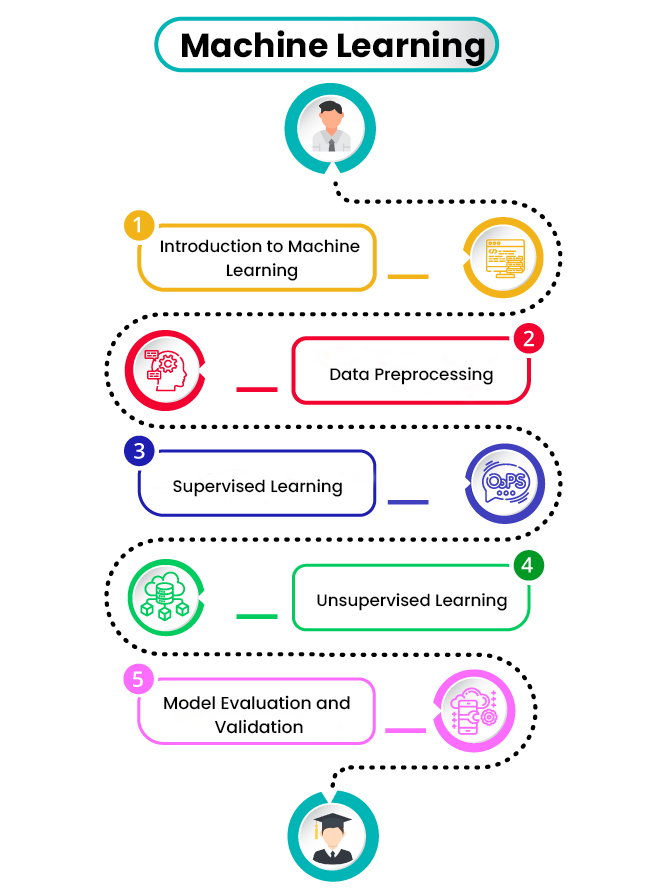
Introduction to Machine Learning
  • Overview of Machine Learning
  • Types of Machine Learning algorithms
  • Applications of Machine Learning in various domains
  • Introduction to Python and popular ML libraries
  • NumPy, Pandas, and scikit-learn
  • Data Preprocessing and Exploration
  • Data cleaning and handling missing values
  • Data transformation techniques (scaling, normalization)
  • Feature selection and engineering
  • Exploratory Data Analysis (EDA) using visualizations
  • Supervised Learning Algorithms
  • Linear Regression
  • Logistic Regression
  • Decision Trees and Random Forests
  • Support Vector Machines (SVM)
  • Naive Bayes Classifier
  • Unsupervised Learning Algorithms
  • K-Means Clustering
  • Hierarchical Clustering
  • Principal Component Analysis (PCA)
  • Association Rule Learning (Apriori algorithm)
  • Anomaly detection
  • Model Evaluation and Validation
  • Training and testing datasets
  • Cross-validation techniques
  • Evaluation metrics (accuracy, precision, recall, F1-score)
  • Confusion matrix and ROC curves
  • Bias-Variance tradeoff
  • Ensemble Methods and Model Selection
  • Bagging and Random Forests
  • Boosting and AdaBoost
  • Stacking and Blending
  • Hyperparameter tuning
  • Model selection techniques
  • Deep Learning Fundamentals
  • Introduction to Neural Networks
  • Activation functions
  • Backpropagation and Gradient Descent
  • Convolutional Neural Networks (CNNs)
  • Recurrent Neural Networks (RNNs)
  • Deep Learning Applications
  • Image Classification
  • Object Detection and Localization
  • Natural Language Processing (NLP)
  • Sequence-to-Sequence Models
  • Generative Adversarial Networks (GANs)
  • Reinforcement Learning
  • Markov Decision Processes (MDPs)
  • Q-Learning and Value Iteration
  • Policy Gradient Methods
  • Deep Q-Networks (DQN)
  • Applications of Reinforcement Learning
  • Advanced Topics in Machine Learning
  • Transfer Learning
  • Explainable AI and Interpretability
  • Time Series Analysis
  • Autoencoders and Variational Autoencoders
  • Model Deployment and serving with cloud platforms
  • Curriculum in Machine Learning

    Machine Learning Is Preferred by Over 35% of Developers. Machine Learning is the most widely used and in-demand programming language in the IT industry.

    • Overview of Machine Learning
    • Types of Machine Learning algorithms
    • Applications of Machine Learning in various domains
    • Introduction to Python and popular ML libraries
    • NumPy, Pandas, and scikit-learn
    • Data cleaning and handling missing values
    • Data transformation techniques (scaling, normalization)
    • Feature selection and engineering
    • Exploratory Data Analysis (EDA) using visualizations
    • Linear Regression
    • Logistic Regression
    • Decision Trees and Random Forests
    • Support Vector Machines (SVM)
    • Naive Bayes Classifier
    • K-Means Clustering
    • Hierarchical Clustering
    • Principal Component Analysis (PCA)
    • Association Rule Learning (Apriori algorithm)
    • Anomaly detection
    • Training and testing datasets
    • Cross-validation techniques
    • Evaluation metrics (accuracy, precision, recall, F1-score)
    • Confusion matrix and ROC curves
    • Bias-Variance tradeoff
    • Bagging and Random Forests
    • Boosting and AdaBoost
    • Stacking and Blending
    • Hyperparameter tuning
    • Model selection techniques
    • Introduction to Neural Networks
    • Activation functions
    • Backpropagation and Gradient Descent
    • Convolutional Neural Networks (CNNs)
    • Recurrent Neural Networks (RNNs)
    • Image Classification
    • Object Detection and Localization
    • Natural Language Processing (NLP)
    • Sequence-to-Sequence Models
    • Generative Adversarial Networks (GANs)
    • Markov Decision Processes (MDPs)
    • Q-Learning and Value Iteration
    • Policy Gradient Methods
    • Deep Q-Networks (DQN)
    • Applications of Reinforcement Learning
    • Transfer Learning
    • Explainable AI and Interpretability
    • Time Series Analysis
    • Autoencoders and Variational Autoencoders
    • Model Deployment and serving with cloud platforms

    Machine Learning Training Projects

    Develop Your Machine Learning Skills With Useful and Interesting Projects.


    Spam Email Detection

    Develop a spam email classifier using the Enron email dataset and basic natural language processing techniques like TF-IDF and Naive Bayes.


    Breast Cancer Detection

    Use a breast cancer dataset to build a simple binary classification model to predict whether a tumor is malignant or benign using algorithms like Logistic Regression or Random Forests.


    Customer Segmentation

    Use clustering algorithms like K-Means or hierarchical clustering to segment customers based on their purchase history and demographics.


    Music Genre Classification

    Create a model to classify music into different genres using audio features extracted from audio files and algorithms like Random Forest or Gradient Boosting.


    Human Activity Recognition

    Develop a model to recognize human activities (e.g., walking, running, sitting) using sensor data from smartphones or wearable devices.


    Image Classification with CNN

    Develop an image classification model using Convolutional Neural Networks (CNNs) to classify images from datasets like CIFAR-10 or Fashion MNIST.


    Natural Language Generation

    Build a natural language generation (NLG) model to generate human-like text based on input data, using techniques like recurrent neural networks or transformer models.


    Dialogue Systems

    Create a conversational AI system or chatbot using natural language processing techniques like sequence-to-sequence models or transformers.


    Multi-modal Fusion

    Develop a model that integrates information from multiple modalities (e.g., text, image, audio) to perform tasks like visual question answering or video captioning.

    Key Highlights

    Our Instructor

    Get advice from specialists who have certifications and are currently working.

    Machine Learning Training Overview

    Within the field of artificial intelligence, machine learning focuses on creating models and algorithms that can learn from data and make predictions or judgments without explicit programming. Fundamentally, machine learning is the application of statistical methods to allow computers to recognize patterns, derive significant conclusions, and make data-driven judgments in a variety of fields. Typically, the procedure entails training a model on a dataset made up of input-output pairs so that it may learn to generalize from examples to predict values for newly discovered data. Every of the four primary kinds of data mining algorithms—supervised acquiring knowledge, unsupervised computation, semi-supervised programming, and reinforcing learning—has a distinctive set of methods and uses.

    Additional Information

    The Most Recent Machine Learning Tools

    • Hugging Face Transformers is a popular open-source library built on top of PyTorch and TensorFlow for natural language processing (NLP). It provides pre-trained models and pipelines for various NLP tasks, such as text classification, language translation, and text generation.
    • Developed by Google Research, JAX is an open-source numerical computing library that combines the flexibility of NumPy with the performance of TensorFlow.
    • Flax is a neural network library developed by Google Research that is built on top of JAX. It provides a flexible and composable interface for defining and training deep learning models, with support for automatic differentiation and custom layers.
    • PyCaret is an open-source machine learning library in Python that simplifies the machine learning workflow by automating various tasks, such as data preprocessing, feature selection, model training, and evaluation. PyCaret is designed to be easy to use for beginners while offering advanced features for experienced users.

    What goals are achieved in a Machine Learning Course?

    In a machine learning course, several goals are typically achieved to equip students with the knowledge, skills, and practical experience needed to understand, apply, and advance in the field of machine learning. Some common goals include:

    • Students learn fundamental concepts and principles of machine learning, including supervised learning, unsupervised learning, reinforcement learning, and other specialized techniques. They gain insights into how machine learning algorithms work, their strengths, limitations, and the underlying mathematical principles.
    • Courses often include practical exercises, projects, and real-world examples to provide students with hands-on experience in applying machine learning techniques to solve practical problems. This hands-on experience helps students develop proficiency in implementing algorithms, working with datasets, and interpreting results.
    • Machine learning courses typically require students to have proficiency in programming languages such as Python, as well as familiarity with relevant libraries and frameworks like TensorFlow, PyTorch, scikit-learn, and others. Students learn how to write code to preprocess data, build and train models, and evaluate performance metrics.
    • Students learn techniques for preprocessing and cleaning data, handling missing values, encoding categorical variables, and scaling features. They also learn about feature selection, extraction, and transformation techniques to improve model performance and interpretability.

    Future works for Machine Learning

    The future of machine learning holds a multitude of exciting possibilities and potential directions for research and development. Some of the key areas of focus and future works in machine learning include:

    • As machine learning models become more complex and pervasive, there is a growing need for transparency and interpretability. Future research will likely focus on developing techniques to explain the decisions made by machine learning models, enabling users to understand and trust AI systems better.
    • Addressing ethical concerns and mitigating biases in machine learning algorithms will continue to be a critical area of research. Future works will aim to develop techniques for ensuring fairness, accountability, transparency, and interpretability in AI systems, thereby promoting equitable outcomes and minimizing unintended consequences.
    • Enhancing the robustness of machine learning models against adversarial attacks and unforeseen circumstances is a significant challenge. Future research will focus on developing techniques to improve model generalization, resilience to perturbations, and adaptability to changing environments.
    • Enabling machine learning models to learn continuously from streaming data or evolving environments is essential for building more adaptive and autonomous systems. Future works will explore techniques for continual learning, transfer learning, and lifelong learning, allowing models to accumulate knowledge over time and adapt to new tasks and domains.

    What new Machine Learning frameworks are there?

    • Developed by Google Research, JAX is an open-source framework for numerical computing that combines the flexibility of NumPy with the performance of TensorFlow. JAX provides a functional programming model and supports automatic differentiation, making it well-suited for high-performance machine learning research.
    • Also developed by Google Research, Flax is a neural network library built on top of JAX. It offers a flexible and composable interface for defining and training deep learning models, with support for automatic differentiation, custom layers, and distributed training. Flax aims to provide a user-friendly and efficient framework for building state-of-the-art models.
    • The Hugging Face Transformers library is an open-source framework for natural language processing (NLP) tasks, built on top of PyTorch and TensorFlow. It provides pre-trained models and pipelines for a wide range of NLP tasks, such as text classification, language translation, and question answering, allowing developers to leverage state-of-the-art models with ease.
    • Developed by Google Brain, Trax is a high-level deep learning library focused on simplicity and modularity. It provides a functional API for defining neural network architectures and training models, with support for automatic differentiation and parallel computation. Trax aims to make deep learning more accessible to beginners and researchers alike.
    Show More

    Machine Learning Training Objectives

  • Foundational knowledge in mathematics, including linear algebra, calculus, and probability theory.
  • Familiarity with machine learning concepts, algorithms, and techniques.
  • Practical experience in applying machine learning methods to real-world problems, often demonstrated through projects or work experience.
  • Obtaining a Machine Learning certification can enhance your employability in the field, as it demonstrates your commitment to learning and proficiency in the subject matter. However, it does not guarantee employment. Employers typically consider a combination of factors such as skills, experience, qualifications, and the specific needs of the role when making hiring decisions.

    Yes, you can pursue multiple Machine Learning Course Certifications to broaden your knowledge and skills in different areas of ML. Doing so can help you gain a more comprehensive understanding of the field and increase your versatility as a machine learning practitioner.

  • Vendor-specific certifications offered by companies like Google, Microsoft, IBM, and AWS, focusing on their respective ML platforms and technologies.
  • Academic certifications provided by universities and educational institutions, ranging from short online courses to comprehensive graduate-level programs.
  • Professional certifications offered by independent organizations, covering a wide range of ML topics and often focusing on practical skills and real-world applications.
  • Validation of your skills and expertise in the field.
  • Increased credibility and recognition among employers and peers.
  • Access to networking opportunities within the ML community.
  • For beginners, a certification program that covers foundational concepts and practical applications of Machine Learning would be suitable. Look for courses that provide a gentle introduction to key ML algorithms, programming languages like Python, and popular libraries such as TensorFlow or Scikit-learn.

    Show More

    Industry Statistics

    Jobs / Month

    248

    Avg. Salary

    ₹ 12,55,200

    Job Roles

    Data Analyst

    ML Engineer

    Data Scientist

    AI Engineer

    Machine Learning Certification

    Certificate
    GET A SAMPLE CERTIFICATE
  • Validation of skills and expertise, increasing credibility with employers.
  • Enhanced job opportunities and competitiveness in the market.
  • Access to structured learning materials and resources for deeper understanding.
  • Networking opportunities within the Machine Learning community.
  • Yes, there are various categories of Machine Learning certifications offered, including vendor-specific certifications (such as Google Cloud, Microsoft Azure, AWS, IBM Watson), academic certifications from universities and educational institutions, and professional certifications from independent organizations.

    While having a Machine Learning certification can improve job prospects, it does not guarantee job placement. Employers consider various factors such as skills, experience, qualifications, and fit for the role when making hiring decisions.

    Yes, it is permissible to pursue multiple Machine Learning course certifications to broaden knowledge and skills in different areas of Machine Learning. Doing so can enhance versatility and competitiveness in the job market.

    With a Machine Learning certification, various career prospects become accessible, including roles such as Machine Learning Engineer, Data Scientist, Artificial Intelligence Engineer, Research Scientist, Data Analyst, Business Intelligence Analyst, and Software Engineer.

    Yes, some Machine Learning certification exams offer remote options, allowing candidates to complete exams remotely from their own locations. However, availability may depend on the certifying body and specific exam requirements.

    While real-world experience can be beneficial, it may not always be a requirement for obtaining a Machine Learning certification. Many programs offer a combination of theoretical knowledge and practical application through projects or simulated scenarios.

    Whether the expenditure of time and finances is justified in acquiring an ACTE Machine Learning Certification depends on various factors such as the reputation of the certification, its relevance to career goals, and the opportunities it may provide in the job market. It's essential to research the program, consider career objectives, and evaluate the potential return on investment before making a decision.

    Show More

    The Preferred Partner for 100+ Organizations' Hiring

    Learn from the certified and real time working professionals.

    • Over 100 firms that are looking for top talent for their open positions have come to rely on ACTE as their go-to partner.

    • Businesses have confidence in our ability to match them with the best individuals because of our considerable expertise and proven track record of success.

    • In this section, we'll examine the primary elements influencing this trust and examine how our constant commitment to excellence regularly results in remarkable results for our clients.

    Corporate Clients

    Machine Learning Course Duration and Fees

    Level Course Duration Fees Structure
    Basic 1 - 1.5 Months ₹7,000 - ₹9,000
    Advanced 1.5 - 2 Months ₹7,000 - ₹10,000

    Job Opportunities in Machine Learning

    Machine Learning is preferred by more than 35% of developers. The most widely used and in-demand programming language in the tech industry is Machine Learning.

    Salary In Machine Learning
    Reach Our Placement Officer

    You can Work as a

    AI Product ManagerAI EthicistMLOps EngineerAI Consultant AI ArchitectAI TrainerAI Curriculum Developer

    Upcoming In-Demand Jobs

    Machine Learning ResearcherAI Software DeveloperAI Systems AnalystAI Solution ArchitectAI Project Manager

    Student Testimonials

    100% Placement

    7000+ Placed Student

    600+ Hiring Partners

    5.5 LPA Average Salary

    Recently Placed Students

    Machine Learning Training FAQ's

    Boost Your Coding Ability: Essential Machine Learning Training for Novices and Experienced

    Machine Learning training involves learning the concepts, algorithms, and techniques used in Machine Learning, a subset of artificial intelligence (AI) that focuses on enabling machines to learn from data and improve their performance over time without being explicitly programmed. Machine Learning training is essential because it equips individuals with the skills to develop predictive models, extract insights from data, automate processes, and make informed decisions, which are increasingly valuable in various industries and domains.

    While prior programming experience is not always mandatory, it can be beneficial for individuals undertaking Machine Learning training. Understanding programming concepts and having proficiency in languages like Python, R, or Java can facilitate the learning process and help individuals implement algorithms and models effectively. However, some introductory Machine Learning courses may cater to beginners and provide necessary programming foundations as part of the training.

  • Introduction to Machine Learning and its applications
  • Supervised learning (e.g., regression, classification)
  • Unsupervised learning (e.g., clustering, dimensionality reduction)
  • Deep learning and neural networks
  • Model evaluation and validation
  • Feature engineering and selection
  • Optimization algorithms
  • Practical applications and case studies
  • The typical length of an Machine Learning training course can vary depending on factors such as the depth of coverage, the intensity of the program, and the format of delivery. Some introductory courses may be completed in a few weeks, while more comprehensive or advanced programs may span several months. Additionally, the length of the course may be adjusted based on whether it is delivered full-time, part-time, or through self-paced online learning.

  • Basic understanding of mathematics and statistics
  • Familiarity with programming languages such as Python, R, or Java
  • Knowledge of data structures and algorithms
  • Some courses may also have prerequisites related to prior experience in data analysis, computer science, or related fields.
  • Yes, many Machine Learning training programs offer certifications upon completion. These certifications validate the individual's proficiency in Machine Learning concepts, algorithms, and techniques and can be beneficial for career advancement or further education in the field. However, it's essential to ensure that the certification is recognized and respected in the industry to maximize its value.

    Show More

    Many online Machine Learning courses do offer certificates upon successful completion. These certificates validate the learner's understanding and proficiency in Machine Learning concepts and techniques. However, the availability of certificates may vary depending on the course provider and the specific course. It's essential to check the course details to confirm if a certificate is offered.

  • Understanding complex concepts
  • Lack of hands-on experience
  • Staying motivated and disciplined
  • Keeping up with rapidly evolving technology
  • Yes, most online Machine Learning courses provide opportunities to engage with instructors or pose questions. This may be facilitated through discussion forums, live Q&A sessions, office hours, or email correspondence. Instructors often encourage active participation and are available to provide guidance, clarification, and support to learners throughout the course.

    Yes, there are specialized online Machine Learning courses designed for specific career paths, such as data science, web development, healthcare analytics, finance, and more. These courses may focus on applying Machine Learning techniques to specific domains or industries and often cover relevant tools, technologies, and case studies tailored to the chosen career path.

  • An elementary comprehension of probability, linear algebra, and calculus.
  • Ability to program in languages like Java, R, or Python.
  • Familiarity with algorithms and data structures.
  • Additionally, some courses can suggest having prior knowledge in computer science, data analysis, or similar subjects.
  • Set clear and achievable goals for your learning journey.
  • Create a study schedule and stick to it.
  • Stay connected with peers, mentors, or online communities for support and accountability.
  • Celebrate milestones and progress along the way.
  • Remind yourself of the reasons why you embarked on this learning journey and the potential benefits it can bring to your career or personal development.
  • Stay curious and engaged by exploring new topics, projects, or applications within Machine Learning.
  • Show More
  • Working with real-world datasets to understand data preprocessing, feature engineering, and exploration.
  • Implementing Machine Learning algorithms and techniques to solve business problems or predictive modeling tasks.
  • Developing and deploying machine learning models using industry-standard tools and platforms.
  • Collaborating with peers on team projects or case studies to apply learned concepts in practical scenarios.
  • Receiving guidance and feedback from instructors or mentors to enhance learning outcomes and address challenges effectively.
  • Pre- and post-training assessments to measure improvements in knowledge, skills, and performance.
  • Tracking key performance indicators (KPIs) related to business objectives, such as productivity, efficiency, and revenue.
  • Gathering feedback from participants through surveys or interviews to assess the perceived value and impact of the training.
  • Analyzing business outcomes and comparing them with the investment made in training to determine the overall ROI.
  • Monitoring employee engagement, retention, and satisfaction levels to evaluate the long-term impact of training on workforce development and organizational performance.
  • Instructor-led sessions, workshops, or office hours for guidance and clarification.
  • Online forums, discussion groups, or community platforms for peer support and knowledge sharing.
  • Learning materials, tutorials, and documentation to reinforce learning and provide ongoing reference.
  • Access to relevant tools, software, and datasets for practicing and applying learned concepts.
  • Continuing education opportunities, such as advanced courses, certifications, or conferences, to further develop skills and stay updated on industry trends.
  • Yes, employees with different levels of programming experience can derive value from Machine Learning corporate training. Training programs can be designed to accommodate participants with varying levels of proficiency, from beginners to advanced learners. Introductory modules can provide foundational knowledge and programming skills, while more advanced topics can cater to experienced programmers seeking to deepen their understanding of Machine Learning algorithms and techniques.

  • Empowering employees with the skills and knowledge needed to leverage data effectively, make data-driven decisions, and develop innovative solutions.
  • Enhancing workforce productivity, efficiency, and agility through automation, optimization, and predictive analytics.
  • Enabling the development of advanced products, services, and solutions that differentiate your organization from competitors and meet evolving customer needs.
  • Fostering a culture of innovation, experimentation, and continuous learning within the organization, driving ongoing improvement and adaptation to market changes.
  • The pricing structure for Machine Learning corporate training may vary depending on factors such as the course provider, training format, customization requirements, and number of participants. Pricing models may include per-person pricing, bulk discounts for larger groups, or customized packages tailored to specific organizational needs. Cost-saving opportunities for larger groups of employees may include volume discounts, enterprise agreements, or bundled services that combine training with other offerings, such as consulting or support services. It's essential to discuss pricing and negotiation options with training providers to find a solution that aligns with your budget and requirements.

    Show More