Cloud Computing Training In Online 100% Job Guarantee

  • Classes for Beginners and Experts.
  • 320+ Employing Clients and Over 11402 Students Trained.
  • Learn Top Tips for Novice to Expert Level Courses.
  • Presented by a Cloud Computing Certified Expert with Over 9 Years of Experience.
  • Access to the study materials, videos, and student portal for life.

Explore the factors that draw more than 25,000 students to ACTE.

Curriculum in Cloud Computing

Linux Fundamentals
  • Automating Programs
  • Login Options
  • Key Filesystem Locations
  • BASH – Borne Again Shell
  • User Management
  • The /proc Pseudo Filesystem
  • Software Management
  • Hardware Management
  • Network Management
  • The X Window System
  • Building a Custom Linux Kernel
  • Kernel Versions
  • Kernel Source Files
  • Kernel Patch Files
  • Kernel Configuration
  • Kernel Building
  • Testing a New Kernel
  • The GNU/Linux Filesystem
  • Partition Types
  • Filesystem Types
  • Mounting
  • Automount
  • File Types
  • File Security
  • AWS (Amazon Web Services)
  • Introduction to AWS
  • EC2
  • Storage
  • Route 53
  • Cloud Front/Content Delivery Network
  • IAM
  • Relational Database Service
  • Monitoring (Cloud Trail & Cloud Watch)
  • Application Services
  • Design and Architecture
  • Virtual Private Cloud
  • VPC
  • Subnets
  • Route Tables
  • Internet gateway
  • Load Balancing and Autoscaling
  • Classic Load balancer
  • Application Load balancer
  • Network Load balancer
  • DynamoDB
  • Scaling through performance
  • Server less environment
  • Microservices
  • Introduction to DevOps
  • DevOps Principles in detail
  • DevOps Engineer Skills in the market
  • Knowing DevOps Delivery Pipeline
  • The market trend of DevOps
  • DevOps Technical Challenges
  • Tools we use in DevOps
  • DevOps on Cloud
  • Essentials of Cloud computing?
  • Cloud and virtualization architecture
  • Cloud deployment architecture
  • Cloud providers – An overview
  • Why we need DevOps on Cloud?
  • Introducing to Amazon web services
  • Jenkins – Continuous integration
  • Essentials of Continuous Integration
  • An example scenario where CI is used
  • Know about Jenkins and its architecture in detail
  • Jenkins tool Management in detail
  • Know about User management in Jenkins
  • Adding a slave node to Jenkins
  • Building Delivery Pipeline
  • Notification settings in Jenkins
  • Plugin management in Jenkins
  • Docker – A containerization technology
  • Introduction
  • Working with container
  • Introduction to Docker Networking
  • Docker Swarm – An introduction
  • Kubernetes
  • Introduction to Kubernetes
  • Kubernetes Cluster Architecture – An overview
  • Understanding concepts of Pods, Replica sets, deployments and namespaces
  • Understanding the concepts of services and networking
  • Persistent volumes and persistent volume claims – an overview
  • Design of Pods
  • Microsoft Azure
  • Introduction to Cloud Computing
  • Introduction to Azure
  • Configuration Management, Automation, and Debugging
  • Commands
  • Networking in Azure
  • Scaling in Azure
  • Monitoring in Azure
  • High Availability
  • Azure AD
  • Azure Service Bus Messaging
  • Azure Key Vaults
  • Web & Mobile Services
  • Azure VMs and Storage Accounts
  • VM Architecture
  • Deploy VMs
  • Create Storage Accounts for VMs
  • Create a VM with Unmanaged Storage
  • Manage VM Disks
  • Configure Shared Storage
  • Clean Up
  • Supported Workloads
  • Create a VM and Storage Account in Azure
  • Azure CLI
  • Azure PowerShell
  • Azure Cloud Shell
  • VM Agent and Extensions
  • ARM Templates
  • PowerShell DSC
  • Deploy and Enable Debugging for VM in Dev
  • Terraform Modules
  • Introduction to Modules
  • Module repositories
  • First Basic Module
  • The Module codes
  • Main Terraform Code
  • Using git repositories to save modules
  • Terraform With AWS
  • Setting up the system for AWS
  • AWS Storage: The S3 Bucket and Random ID
  • AWS Storage: The Root Module
  • AWS Compute: AMI Data, Key Pair, and the File Function
  • AWS Compute: The EC2 Instance
  • AWS Compute: User Data and Template Files
  • AWS Compute: The Root Module
  • AWS Networking: VPC, IGW, and Route Tables
  • AWS Networking: Subnets, Security, and the Count Attribute
  • AWS Networking: The Root Module
  • Curriculum in Cloud Computing

    Cloud Computing Is Preferred by Over 35% of Developers. Cloud Computing is the most widely used and in-demand programming language in the IT industry.

    • Automating Programs
    • Login Options
    • Key Filesystem Locations
    • BASH – Borne Again Shell
    • User Management
    • The /proc Pseudo Filesystem
    • Software Management
    • Hardware Management
    • Network Management
    • The X Window System
    • Kernel Versions
    • Kernel Source Files
    • Kernel Patch Files
    • Kernel Configuration
    • Kernel Building
    • Testing a New Kernel
    • Partition Types
    • Filesystem Types
    • Mounting
    • Automount
    • File Types
    • File Security
    • Introduction to AWS
    • EC2
    • Storage
    • Route 53
    • Cloud Front/Content Delivery Network
    • IAM
    • Relational Database Service
    • Monitoring (Cloud Trail & Cloud Watch)
    • Application Services
    • Design and Architecture
    • VPC
    • Subnets
    • Route Tables
    • Internet gateway
    • Classic Load balancer
    • Application Load balancer
    • Network Load balancer
    • Scaling through performance
    • Server less environment
    • Microservices
    • DevOps Principles in detail
    • DevOps Engineer Skills in the market
    • Knowing DevOps Delivery Pipeline
    • The market trend of DevOps
    • DevOps Technical Challenges
    • Tools we use in DevOps
    • Essentials of Cloud computing?
    • Cloud and virtualization architecture
    • Cloud deployment architecture
    • Cloud providers – An overview
    • Why we need DevOps on Cloud?
    • Introducing to Amazon web services
    • Essentials of Continuous Integration
    • An example scenario where CI is used
    • Know about Jenkins and its architecture in detail
    • Jenkins tool Management in detail
    • Know about User management in Jenkins
    • Adding a slave node to Jenkins
    • Building Delivery Pipeline
    • Notification settings in Jenkins
    • Plugin management in Jenkins
    • Introduction
    • Working with container
    • Introduction to Docker Networking
    • Docker Swarm – An introduction
    • Introduction to Kubernetes
    • Kubernetes Cluster Architecture – An overview
    • Understanding concepts of Pods, Replica sets, deployments and namespaces
    • Understanding the concepts of services and networking
    • Persistent volumes and persistent volume claims – an overview
    • Design of Pods
    • Introduction to Cloud Computing
    • Introduction to Azure
    • Configuration Management, Automation, and Debugging
    • Commands
    • Networking in Azure
    • Scaling in Azure
    • Monitoring in Azure
    • High Availability
    • Azure AD
    • Azure Service Bus Messaging
    • Azure Key Vaults
    • Web & Mobile Services
    • VM Architecture
    • Deploy VMs
    • Create Storage Accounts for VMs
    • Create a VM with Unmanaged Storage
    • Manage VM Disks
    • Configure Shared Storage
    • Clean Up
    • Supported Workloads
    • Azure CLI
    • Azure PowerShell
    • Azure Cloud Shell
    • VM Agent and Extensions
    • ARM Templates
    • PowerShell DSC
    • Deploy and Enable Debugging for VM in Dev
    • Introduction to Modules
    • Module repositories
    • First Basic Module
    • The Module codes
    • Main Terraform Code
    • Using git repositories to save modules
    • Setting up the system for AWS
    • AWS Storage: The S3 Bucket and Random ID
    • AWS Storage: The Root Module
    • AWS Compute: AMI Data, Key Pair, and the File Function
    • AWS Compute: The EC2 Instance
    • AWS Compute: User Data and Template Files
    • AWS Compute: The Root Module
    • AWS Networking: VPC, IGW, and Route Tables
    • AWS Networking: Subnets, Security, and the Count Attribute
    • AWS Networking: The Root Module

    Cloud Computing Training Projects

    Develop Your Cloud Computing Skills With Useful and Interesting Projects.


    Serverless Contact Form

    Build a serverless contact form using AWS API Gateway, AWS Lambda, and Amazon SES for email notifications.


    Basic IoT Data Collection

    Set up a basic IoT data collection system using AWS IoT Core for device connectivity and AWS Lambda for data processing.


    Cloud-Based File Conversion

    Develop a simple file conversion service using AWS Lambda and AWS S3.


    Multi-Cloud Disaster Recovery

    Design and implement a multi-cloud disaster recovery solution using AWS, Azure, and/or Google Cloud.


    Cross-Platform Mobile App Backend

    Develop a backend for a cross-platform mobile app using serverless technologies and cloud-based databases.


    Serverless Data Processing Pipeline

    Build a serverless data processing pipeline using AWS Step Functions, AWS Lambda, and AWS Glue.


    Serverless ETL Pipeline

    Create a serverless ETL pipeline for extracting, transforming, and loading data from various sources using AWS Glue, AWS Lambda, and AWS S3.


    Edge Computing Platform

    Develop an edge computing platform for running compute-intensive tasks at the edge of the network using services like AWS Wavelength or Azure Edge Zones.


    Cloud-Native Security Monitoring

    Implement a cloud-native security monitoring solution using services like AWS Security Hub, AWS GuardDuty, and AWS Config.

    Key Highlights

    Our Instructor

    Get advice from specialists who have certifications and are currently working.

    Cloud Computing Training Overview

    Cloud computing is a transformative paradigm that revolutionizes the way businesses and individuals access, store, and manage data, applications, and services over the internet. At its core, cloud computing provides on-demand access to a shared pool of computing resources, including servers, storage, networking, and software, delivered as a service. This shift to cloud-based infrastructure enables organizations to scale resources dynamically, pay only for what they use, and offload the burden of infrastructure management to cloud providers. With cloud computing, users can access their data and applications from anywhere with an internet connection, fostering greater flexibility, agility, and collaboration.

    Additional Information

    What Does the Growth of Cloud Computing Look Like in the Coming Years?

    The growth of cloud computing in the coming years is expected to be robust, driven by several key factors that indicate sustained expansion and adoption across industries and geographies. Here's a glimpse into what the growth of cloud computing might look like in the coming years:

    • Cloud computing is becoming increasingly integral to businesses of all sizes and across various industries. As organizations continue to recognize the benefits of cloud technology, including scalability, flexibility, cost-effectiveness, and agility, the adoption of cloud services is expected to accelerate across sectors such as healthcare, finance, retail, manufacturing, and government.
    • Cloud providers are continuously expanding their service offerings to meet the evolving needs of customers. From infrastructure as a service (IaaS) and platform as a service (PaaS) to software as a service (SaaS), cloud providers are diversifying their portfolios and introducing new services and features to drive innovation and address specific use cases.
    • Edge computing, which brings computation and data storage closer to the location where it is needed, is gaining traction as organizations seek to leverage real-time data processing and low-latency interactions for edge devices and applications. The integration of edge computing with cloud infrastructure is expected to drive new opportunities for hybrid cloud deployments and enable more distributed and intelligent architectures.
    • Cloud providers are integrating artificial intelligence (AI) and machine learning (ML) capabilities into their platforms to enable customers to build intelligent applications and services. As AI and ML become more accessible through cloud-based APIs and tools, organizations will increasingly leverage these technologies to gain insights, automate processes, and deliver personalized experiences to customers.

    Cloud Computing Course Career Opportunities:

    A Cloud Computing Course opens up a wide array of career opportunities in the rapidly growing field of cloud technology. Here are some of the career paths and opportunities available to individuals who complete a cloud computing course:

    • Cloud security specialists focus on protecting cloud environments from cybersecurity threats and vulnerabilities. They implement security controls, monitor for suspicious activities, conduct security assessments and audits, and ensure compliance with regulatory requirements.
    • Cloud DevOps engineers combine development and operations practices to automate and streamline the deployment and management of cloud-based applications and infrastructure. They use tools and methodologies such as continuous integration/continuous deployment (CI/CD), infrastructure as code (IaC), and monitoring and logging to optimize cloud operations.
    • Cloud data engineers specialize in designing and implementing data pipelines, data lakes, and analytics solutions on cloud platforms. They use technologies such as big data frameworks, data warehouses, and machine learning tools to extract, transform, and analyze data for business insights and decision-making.
    • Cloud solutions architects design and implement end-to-end solutions that leverage cloud technologies to address specific business requirements and challenges. They work closely with stakeholders to understand business needs, recommend cloud solutions, and oversee the implementation and integration of cloud services.

    Future Prospects and Techniques in Cloud Computing

    The future prospects of cloud computing are bright, with several emerging trends and techniques shaping the evolution of the industry. Here are some future prospects and techniques in cloud computing:

    • Serverless computing, also known as Function as a Service (FaaS), is gaining popularity as a cloud computing model that abstracts server management and allows developers to focus on writing code in the form of functions.
    • Edge computing brings computation and data storage closer to the location where it is needed, enabling real-time processing and low-latency interactions for edge devices and applications.
    • Organizations are adopting hybrid and multi-cloud strategies to leverage the strengths of different cloud providers and on-premises infrastructure. This trend is driving the development of tools and platforms that facilitate seamless integration, management, and orchestration of workloads across heterogeneous cloud environments, enabling organizations to optimize performance, minimize vendor lock-in, and ensure redundancy and resilience.
    • Cloud providers are integrating artificial intelligence (AI) and machine learning (ML) capabilities into their platforms to enable customers to build intelligent applications and services.

    Suitable Job Roles for Cloud Computing :

    Cloud computing offers a wide range of job roles across various domains and skill levels. Here are some suitable job roles for individuals with expertise in cloud computing:

    • Cloud architects design and oversee the implementation of cloud infrastructure and solutions.
    • Cloud engineers are responsible for implementing and managing cloud infrastructure and services. They configure and deploy virtual machines, storage resources, networking components, and other cloud resources, and ensure the availability, performance, and security of cloud environments.
    • They use programming languages and development tools to create cloud-native applications, integrate with cloud services, and optimize performance and scalability.
    • Cloud administrators manage and maintain cloud infrastructure and services. They configure and monitor cloud resources, manage user access and permissions, troubleshoot issues, and ensure compliance with security and governance policies.
    Show More

    Enter details. Get MNC calls!

    Cloud Computing Training Objectives

    To obtain an authorized Cloud Computing certification, you can enroll in training programs offered by reputable providers such as Amazon Web Services (AWS), Microsoft Azure, Google Cloud Platform (GCP), CompTIA, or other recognized organizations. These programs typically include study materials, hands-on labs, and exams to validate your knowledge and skills in cloud computing technologies and platforms.

    Cloud Computing certifications offer several advantages, including validation of your expertise and skills in cloud technologies, increased job opportunities and career advancement, higher earning potential, recognition by employers and peers, and the opportunity to stay updated with the latest trends and best practices in cloud computing.

    The significance of Cloud Computing training certification lies in its ability to validate your knowledge and skills in cloud technologies, making you more marketable to employers seeking professionals with cloud computing expertise. Certification demonstrates your commitment to continuous learning and professional development in a rapidly evolving field, enhancing your credibility and confidence in your abilities.

    The skill set necessary to get Cloud Computing certification includes proficiency in cloud platforms and services such as AWS, Azure, or GCP, understanding of cloud deployment models (public, private, hybrid), knowledge of cloud security best practices, expertise in cloud migration and management, familiarity with DevOps practices and tools for automation and continuous integration/continuous deployment (CI/CD), and the ability to design scalable and resilient cloud architectures.

    Yes, obtaining a Cloud Computing certification can often lead to a salary increase. Certified professionals typically command higher salaries compared to their non-certified counterparts due to their validated expertise and skills in cloud technologies. The exact salary increase may vary depending on factors such as your level of experience, the specific certification obtained, the demand for cloud skills in your geographic location, and the industry you work in.

  • Cloud architects
  • Cloud engineers
  • Cloud administrators
  • DevOps engineers
  • Cybersecurity specialists focusing on cloud security
  • Show More

    Industry Statistics

    Jobs / Month

    248

    Avg. Salary

    ₹ 12,55,200

    Job Roles

    Cloud Support Engineer

    Cloud Solutions Architect

    Systems Administrator

    DevOps Engineer

    Cloud Computing Certification

    Certificate
    GET A SAMPLE CERTIFICATE

    Cloud Computing certifications offer several advantages, including validation of your expertise and skills in cloud technologies, increased job opportunities and career advancement, higher earning potential, recognition by employers and peers, and the opportunity to stay updated with the latest trends and best practices in cloud computing.

    Yes, there are multiple types of Cloud Computing certifications available from various providers such as Amazon Web Services (AWS), Microsoft Azure, Google Cloud Platform (GCP), CompTIA, and others. These certifications cater to different roles, expertise levels, and cloud platforms, allowing individuals to specialize in specific areas of cloud computing based on their career goals and interests.

    Holding a Cloud Computing certification does not guarantee employment, but it can significantly improve your chances of finding a job in the field. Certification enhances your resume, demonstrates your proficiency in cloud technologies to employers, and makes you more competitive in the job market. However, securing employment ultimately depends on various factors such as job availability, your skills and experience, and how well you perform in interviews.

    Yes, you are allowed to seek multiple Cloud Computing course certifications to broaden your knowledge and skills across different cloud platforms and services. Many professionals opt to obtain certifications from multiple providers to showcase versatility and proficiency in various cloud environments, which can enhance their career opportunities and earning potential.

    With a Cloud Computing certification, various employment opportunities become available, including roles such as cloud architect, cloud engineer, cloud administrator, DevOps engineer, cloud security specialist, and IT manager overseeing cloud migration and operations. These roles involve designing, implementing, managing, and securing cloud infrastructure and services for organizations across different industries.

    Yes, many Cloud Computing certification exams offer an online option that allows candidates to take the exam remotely from their own homes or offices. Online proctored exams are often available, where candidates are monitored remotely to ensure exam integrity.

    While real-world experience can be beneficial for preparing for a Cloud Computing certification exam, it is not always necessary to obtain certification. Many certification programs provide comprehensive training materials and resources to help candidates prepare for the exam, regardless of their level of experience.

    Whether the investment of time and money in obtaining an ACTE Cloud Computing Certification is justified depends on your career goals, the specific certification program offered by ACTE, and its alignment with your interests and aspirations. It's essential to research the certification program, review the curriculum, consider the reputation of the certification provider, and assess the demand for certified professionals in the job market before making a decision.

    Show More

    The Preferred Partner for 100+ Organizations' Hiring

    Learn from the certified and real time working professionals.

    • Over 100 firms that are looking for top talent for their open positions have come to rely on ACTE as their go-to partner.

    • Businesses have confidence in our ability to match them with the best individuals because of our considerable expertise and proven track record of success.

    • In this section, we'll examine the primary elements influencing this trust and examine how our constant commitment to excellence regularly results in remarkable results for our clients.

    Corporate Clients

    Cloud Computing Course Duration and Fees

    Level Course Duration Fees Structure
    Basic 1 - 1.5 Months ₹7,000 - ₹9,000
    Advanced 1.5 - 2 Months ₹7,000 - ₹10,000

    Job Opportunities in Cloud Computing

    Cloud Computing is preferred by more than 35% of developers. The most widely used and in-demand programming language in the tech industry is Cloud Computing.

    Salary In Cloud Computing
    Reach Our Placement Officer

    You can Work as a

    Cloud Operations ManagerCloud Data EngineerCloud ConsultantCloud Software EngineerCloud Project ManagerCloud Compliance AnalystCloud Sales Engineer

    Upcoming In-Demand Jobs

    Cloud Business AnalystCloud Product ManagerCloud Training SpecialistCloud Account ManagerSolutions Developer

    Student Testimonials

    100% Placement

    7000+ Placed Student

    600+ Hiring Partners

    5.5 LPA Average Salary

    Recently Placed Students

    Cloud Computing Training FAQ's

    Boost Your Coding Ability: Essential Cloud Computing Training for Novices and Experienced

    Delivering computer services over the Internet (often known as "the cloud") allows for speedier innovation, more flexible resource usage, and scalability benefits. These services include servers, storage, databases, networking, software, and more. In essence, consumers may get computer resources from cloud service providers like Amazon Web Services (AWS), Microsoft Azure, or Google Cloud Platform (GCP) on-demand rather than purchasing and maintaining actual data centers and servers.

    Cloud Computing training involves educational programs or courses designed to equip individuals with the knowledge, skills, and expertise needed to effectively utilize cloud computing technologies and services. These training programs cover various aspects of cloud computing, including cloud infrastructure, deployment models, service models, security, management, and optimization.

  • Career advancement
  • Industry relevance
  • Flexibility and scalability
  • Cost-effectiveness
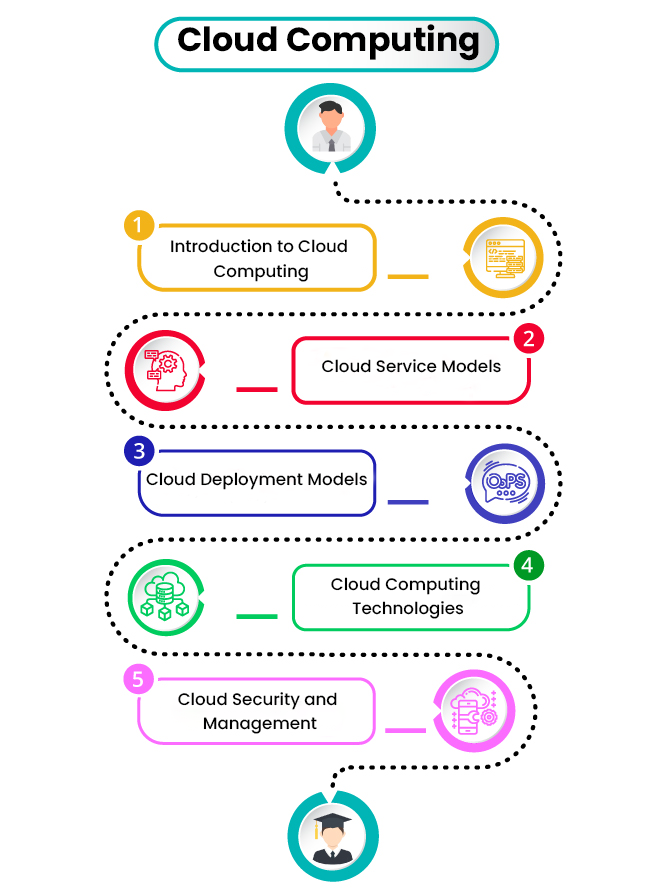
  • Introduction to cloud computing
  • Cloud service models
  • Cloud deployment models
  • Cloud infrastructure and architecture
  • Cloud security
  • Cloud management and optimization
  • The duration of Cloud Computing training can vary depending on factors such as the depth of the curriculum, the training format (e.g., intensive boot camps vs. part-time courses), and individual learning pace. Some training programs may be completed in a matter of days or weeks, while others may span several months. Certification preparation courses often range from a few days to several weeks, depending on the level of certification and the candidate's existing knowledge and experience.

  • Understand the exam objectives
  • Enroll in a certification preparation course
  • Study the recommended resources
  • Practice with hands-on labs
  • Take practice exams
  • Review and reinforce your knowledge
  • Stay updated
  • Show More
  • Basic understanding of computer science fundamentals, including networking, operating systems, and data structures.
  • Familiarity with essential programming concepts and languages (e.g., Python, Java) can be beneficial, although not always required.
  • Some courses may assume prior knowledge of cloud computing basics, such as cloud service models (IaaS, PaaS, SaaS) and deployment models (public, private, hybrid).
  • Certain advanced courses may have additional prerequisites, such as experience with specific cloud platforms or technologies.
  • Set clear goals
  • Break it down
  • Stay organized
  • Stay engaged
  • Reward yourself
  • Stay connected to your why
  • Take notes
  • Practice with hands-on labs
  • Engage with the material
  • Teach others
  • Review regularly
  • Seek clarification
  • Stay persistent
  • Yes, it is feasible to acquire Cloud Computing skills through online learning without any prior programming experience. Many introductory Cloud Computing courses are designed to cater to beginners and assume no prior programming knowledge. These courses typically start with foundational concepts and gradually build up to more advanced topics, allowing learners to develop their skills progressively.

    Yes, many online Cloud Computing courses offer certificates of completion to participants who successfully finish the course requirements. These certificates can serve as proof of your accomplishment and demonstrate your proficiency in cloud computing concepts and skills. However, it's essential to ensure that the course you enroll in is offered by a reputable provider and recognized within the industry for its quality and relevance.

    Online Cloud Computing training can be effective for beginners, provided that the courses are well-designed, structured, and comprehensive. Beginner-friendly courses typically start with foundational concepts and gradually progress to more advanced topics, allowing learners to build their knowledge and skills at their own pace. Additionally, online courses often offer flexibility in terms of scheduling and access to resources, making them accessible to learners with varying backgrounds and learning styles.

    Show More
  • It enables employees to leverage cloud technologies efficiently, leading to improved productivity, innovation, and cost-effectiveness.
  • It helps your organization stay competitive in a rapidly evolving technological landscape by ensuring that your workforce is equipped with the latest cloud computing skills.
  • It fosters a culture of continuous learning and professional development, enhancing employee satisfaction and retention.
  • It mitigates risks associated with cloud adoption by providing employees with the necessary knowledge and expertise to address security, compliance, and operational challenges.
  • Providing employees with a solid understanding of cloud computing concepts, principles, and best practices.
  • Equipping employees with practical skills to deploy, manage, and optimize cloud resources effectively.
  • Enhancing security awareness and expertise to mitigate risks associated with cloud adoption.
  • Empowering employees to leverage cloud technologies for innovation, agility, and scalability in their day-to-day tasks and projects.
  • Aligning training objectives with organizational goals and strategies to maximize the impact of cloud computing adoption on business outcomes.
  • Customized curriculum
  • Case studies and examples
  • Hands-on labs and simulations
  • Flexible delivery formats
  • Offering flexible scheduling options, such as weekend sessions, evening classes, or staggered modules, to accommodate employees' work commitments.
  • Customizing the training schedule to align with your organization's operational needs and peak business periods, minimizing disruptions to daily workflows.
  • Providing on-demand access to training materials and resources, allowing employees to learn at their own pace and convenience while balancing their work responsibilities.
  • Professional certifications in cloud computing platforms such as AWS Certified Solutions Architect, Microsoft Certified: Azure Solutions Architect Expert, or Google Cloud Certified Professional Cloud Architect.
  • Extensive hands-on experience working with cloud technologies in various roles such as cloud architect, cloud engineer, or cloud consultant.
  • Teaching and training experience in delivering corporate training programs, workshops, or educational courses on cloud computing topics.
  • Strong communication and presentation skills to effectively convey complex technical concepts and facilitate engaging learning experiences for participants.
  • Introduction to cloud computing
  • Cloud service models
  • Cloud deployment models
  • Cloud infrastructure and architecture
  • Cloud security
  • Cloud management and optimization
  • Show More