Artificial Intelligence Training In Online 100% Job Guarantee

  • Classes for Beginners and Experts.
  • Best MNC Interview Questions Answered.
  • Budget-friendly fees and a curriculum created by industry experts.
  • Presented by a Certified Artificial Intelligence Trainer Expert with Over Nine Years of Experience.
  • This week will see the start of the next batch of AI training. Put Your Name Into Action Right Now!

Explore the factors that draw more than 25,000 students to ACTE.

Curriculum in Artificial Intelligence

Foundation of AI & ML
  • Introduction to Data Science, AI&ML
  • R Essentials
  • Statistical Analysis
  • Python for Artificial Intelligence
  • Python Essentials
  • Python Environment Setup
  • Python Data Types
  • Python Looping and Control Statements
  • Object-Oriented Programming Concepts
  • Database Connection
  • Python Libraries for Artificial Intelligence
  • Numpy
  • Scipy
  • Pandas
  • MatPlot
  • Data Management
  • Data Acquisition
  • Data Pre-processing and Preparation
  • Data Transformation and Quality
  • Handling Text Data
  • Big Data Fundamentals
  • Big Data Frameworks(Spark, Hadoop, NoSQL)
  • SAS-Data Analytics
  • SAS Introduction
  • SAS Functions
  • SAS Operators
  • SAS Procedures
  • SAS Graphs
  • SAS Macros
  • SAS Format
  • Statistical Decision Making
  • Data Visualisation
  • Sampling and Estimation
  • Inferential Statistics
  • Predictive Analytics
  • Linear Regression
  • Multiple Linear Regression
  • Non-Linear Regression
  • Forecasting Models
  • Machine Learning
  • ML Foundations
  • Clustering
  • Classification(Naive Bayes Classifier, K-Nearest Neighbors)
  • Association Rule Mining
  • Artificial Intelligence
  • Foundations of AI
  • Convolution Neural Networks
  • Recurrent Neural Networks
  • Deep Learning with Keras and TensorFlow
  • Deep Learning Libraries
  • Keras API
  • TensorFlow
  • Deep Learning Algorithms
  • Advanced Deep Learning and Computer Vision
  • Distributed and Parallel Computing
  • Deploying Deep Learning Models
  • Reinforcement Learning
  • Generating Images with Neural Style
  • Object Detection through Convolutional Neural Networks
  • Cloud Computing and AWS
  • Introduction to Cloud Computing and AWS
  • Storage Volumes and Elastic Compute
  • Virtual Private Cloud
  • Simple Storage Services
  • AWS Lambda and Amazon Machine Learning
  • Tableau 10
  • Introduction to Data Visualisation
  • Tableau Architecture
  • Working with Data Blending
  • Creation of Sets
  • Calculations, Expression, and Parameters
  • Dashboards, Stories, and Filters
  • Tableau Prep
  • Curriculum in Artificial Intelligence

    Artificial Intelligence Is Preferred by Over 35% of Developers. Artificial Intelligence is the most widely used and in-demand programming language in the IT industry.

    • Introduction to Data Science, AI&ML
    • R Essentials
    • Statistical Analysis
    • Python Essentials
    • Python Environment Setup
    • Python Data Types
    • Python Looping and Control Statements
    • Object-Oriented Programming Concepts
    • Database Connection
    • Numpy
    • Scipy
    • Pandas
    • MatPlot
    • Data Acquisition
    • Data Pre-processing and Preparation
    • Data Transformation and Quality
    • Handling Text Data
    • Big Data Fundamentals
    • Big Data Frameworks(Spark, Hadoop, NoSQL)
    • SAS Introduction
    • SAS Functions
    • SAS Operators
    • SAS Procedures
    • SAS Graphs
    • SAS Macros
    • SAS Format
    • Data Visualisation
    • Sampling and Estimation
    • Inferential Statistics
    • Linear Regression
    • Multiple Linear Regression
    • Non-Linear Regression
    • Forecasting Models
    • ML Foundations
    • Clustering
    • Classification(Naive Bayes Classifier, K-Nearest Neighbors)
    • Association Rule Mining
    • Foundations of AI
    • Convolution Neural Networks
    • Recurrent Neural Networks
    • Deep Learning Libraries
    • Keras API
    • TensorFlow
    • Deep Learning Algorithms
    • Distributed and Parallel Computing
    • Deploying Deep Learning Models
    • Reinforcement Learning
    • Generating Images with Neural Style
    • Object Detection through Convolutional Neural Networks
    • Introduction to Cloud Computing and AWS
    • Storage Volumes and Elastic Compute
    • Virtual Private Cloud
    • Simple Storage Services
    • AWS Lambda and Amazon Machine Learning
    • Introduction to Data Visualisation
    • Tableau Architecture
    • Working with Data Blending
    • Creation of Sets
    • Calculations, Expression, and Parameters
    • Dashboards, Stories, and Filters
    • Tableau Prep

    Artificial Intelligence Training Projects

    Develop Your Artificial Intelligence Skills With Useful and Interesting Projects.


    Predicting House Prices

    Build a regression model to predict the prices of houses based on features like square footage, number of bedrooms, etc.


    Weather Forecasting

    Develop a model to predict weather conditions, such as temperature or precipitation, based on historical data.


    Simple Game AI

    Create a basic AI agent to play simple games like Tic-Tac-Toe or Connect Four.


    Style Transfer

    Implement neural style transfer to create artistic images by combining the style of one image with the content of another.


    Medical Diagnosis

    Build a system for diagnosing medical conditions based on patient symptoms and medical history using machine learning.


    Autonomous Drone Navigation

    Develop algorithms to enable a drone to navigate autonomously and avoid obstacles in its environment.


    Speech Recognition

    Create a system capable of transcribing spoken language into text using deep learning models like RNNs or Transformers.


    Neural Machine Translation with Attention

    Enhance language translation models with attention mechanisms to improve accuracy and fluency.


    Real-Time Object Tracking

    Develop algorithms to track objects in videos in real-time, enabling applications like surveillance or augmented reality.

    Key Highlights

    Our Instructor

    Get advice from specialists who have certifications and are currently working.

    Artificial Intelligence Training Overview

    Artificial intelligence (AI) is a rapidly advancing field of computer science focused on developing systems and technologies that can perform tasks typically requiring human intelligence. These tasks include understanding natural language, recognizing patterns in data, making predictions, and learning from experience. AI systems aim to mimic human cognitive functions such as reasoning, problem-solving, perception, and decision-making, enabling them to automate tasks, assist humans in decision-making processes, and solve complex problems more efficiently. AI encompasses a wide range of techniques and methodologies, including machine learning, deep learning, natural language processing, computer vision, and robotics. As AI technologies continue to evolve, they have the potential to revolutionize industries, transform the way we live and work, and address some of society's most pressing challenges.

    Additional Information

    Artificial Intelligence Uses

    Artificial intelligence (AI) finds application across various domains and industries, revolutionizing processes, improving efficiency, and driving innovation. Some of the key uses of AI include:

    • AI is used to automate repetitive and mundane tasks across industries, such as data entry, customer support, and administrative work, freeing up human resources for more complex and creative endeavors.
    • AI algorithms analyze large datasets to identify patterns, trends, and insights, enabling organizations to make data-driven decisions, forecast outcomes, and optimize processes in areas such as finance, marketing, and supply chain management.
    • AI-powered NLP enables computers to understand, interpret, and generate human language, leading to applications such as virtual assistants, chatbots, sentiment analysis, and language translation.
    • AI-based computer vision systems interpret and analyze visual information from images or videos, enabling applications such as object detection, facial recognition, medical imaging analysis, autonomous vehicles, and surveillance systems.

    Artificial Intelligence Programmer’s Potential Career Paths

    Artificial intelligence (AI) programmers have a diverse range of potential career paths within the field of AI and related industries. Some of the key career paths for AI programmers include:

    • Machine learning engineers design, develop, and implement machine learning algorithms and models to solve complex problems and create AI-powered systems. They work on tasks such as data preprocessing, model training, hyperparameter tuning, and performance optimization.
    • Deep learning engineers specialize in developing deep neural network architectures and models for tasks such as image recognition, natural language processing, speech recognition, and autonomous systems. They work on building and training deep learning models using frameworks such as TensorFlow, PyTorch, and Keras.
    • Data scientists use AI and machine learning techniques to analyze large datasets, extract insights, and derive actionable recommendations for business decisions. They work on tasks such as data cleaning, exploratory data analysis, feature engineering, and predictive modeling.
    • AI researchers conduct research and development in artificial intelligence, exploring new algorithms, techniques, and methodologies to advance the state-of-the-art in AI. They work on fundamental research topics such as reinforcement learning, generative models, and natural language understanding.

    What Are the Requirements for an Artificial Intelligence Training Course?

    The requirements for an artificial intelligence (AI) training course typically include a foundational understanding of programming languages such as Python, Java, or C++, as AI development often involves coding and implementing algorithms. Additionally, familiarity with fundamental mathematical concepts like linear algebra, calculus, probability theory, and statistics is crucial for comprehending and implementing AI algorithms. While not always mandatory, prior experience or coursework in computer science, data science, or related fields is often beneficial to ensure participants have a solid understanding of computer systems and data analysis. Access to a computer with a reliable internet connection and the ability to install necessary software tools and libraries for programming are also common requirements. Motivation, commitment, and a willingness to engage with challenging material are essential for success in AI training courses, as they can be intensive and demanding.

    Reasons to Consider Enrolling in Artificial Intelligence Training

    • By gaining expertise in AI through training, individuals can unlock diverse career opportunities in industries such as technology, healthcare, finance, manufacturing, and more.
    • AI training equips individuals with the knowledge, skills, and techniques needed to design, develop, and deploy AI-powered solutions. Participants learn how to build machine learning models, analyze data, and solve complex problems using AI algorithms and techniques.
    • As AI becomes more prevalent across industries, having AI skills can give individuals a competitive edge in the job market. Employers increasingly value candidates who can leverage AI to drive innovation, improve processes, and deliver business value.
    • AI training fosters creativity and innovation by enabling individuals to explore new ideas, develop novel solutions, and push the boundaries of what is possible with AI technology. Participants learn how to apply AI to solve real-world problems and address societal challenges.
    Show More

    Enter details. Get MNC calls!

    Artificial Intelligence Training Objectives

    Completing an artificial intelligence course certification can potentially lead to a greater salary as it enhances your qualifications and demonstrates proficiency in AI technologies. Employers often value certifications as evidence of specialized skills and may offer higher salaries to certified professionals, especially for roles in high-demand areas of AI such as machine learning, data science, and natural language processing.

  • Proficiency in R, Java, Python, or other programming languages. substantial comprehension of probability theory, linear algebra, and calculus.
  • Familiarity with AI principles and methods, such as neural networks, deep learning, and machine learning.
  • The capacity to work with AI frameworks and tools like PyTorch, TensorFlow, scikit-learn, and Keras.
  • Familiarity with feature engineering, data preparation, and model assessment methods.
  • Critical thinking and problem-solving abilities to apply AI algorithms to practical issues.
  • Validates your expertise and proficiency in AI technologies.
  • Enhances your credibility and marketability as an AI professional.
  • Provides a competitive edge in the job market by distinguishing you from other candidates.
  • Increases your job prospects and opportunities for career advancement.
  • Offers structured learning and skill development in specialized areas of AI.
  • Machine Learning Engineer
  • Data Scientist
  • AI Researcher
  • Natural Language Processing (NLP) Engineer
  • Computer Vision Engineer
  • AI Software Developer
  • AI Consultant
  • AI Product Manager
  • Robotics Engineer
  • Business Intelligence Analyst
  • Obtaining an artificial intelligence certification can potentially lead to a salary increase as it enhances your qualifications and demonstrates specialized expertise in AI technologies. Certified professionals often command higher salaries compared to non-certified counterparts, especially for roles requiring advanced AI skills and experience.

    Yes, many certification tests for artificial intelligence can be taken online. Online proctoring services allow candidates to take exams remotely from their own computers while ensuring the integrity and security of the testing process. Candidates typically need to register for the exam through the certification provider's website, schedule a suitable exam date and time, and follow the specified instructions for online proctoring.

    Show More

    Industry Statistics

    Jobs / Month

    248

    Avg. Salary

    ₹ 12,55,200

    Job Roles

    AI/ML Engineer

    Data Scientist

    Robotics Engineer

    AI Consultant

    Artificial Intelligence Certification

    Certificate
    GET A SAMPLE CERTIFICATE
  • Validation of skills and expertise in AI technologies.
  • Access to exclusive job opportunities and higher salary prospects.
  • Structured learning and skill development in specialized areas of AI.
  • Recognition by employers and industry stakeholders.
  • Machine Learning
  • Deep Learning
  • Natural Language Processing (NLP)
  • Computer Vision
  • Robotics
  • AI Ethics
  • AI Product Management
  • AI Strategy and Leadership
  • AI Programming Languages (e.g., Python, R)
  • While having an artificial intelligence certification can significantly enhance your job prospects and increase your competitiveness in the job market, it does not guarantee job placement on its own. Job opportunities ultimately depend on various factors, including your experience, skills, education, networking, and the demand for AI professionals in the industry.

    Yes, you are allowed to pursue multiple artificial intelligence course certifications to broaden your skill set, specialize in different areas of AI, and increase your marketability in the job market. Pursuing multiple certifications demonstrates your commitment to continuous learning and professional development and allows you to acquire expertise in various AI technologies, methodologies, and applications.

  • Machine Learning Engineer
  • Data Scientist
  • AI Researcher
  • Natural Language Processing (NLP) Engineer
  • Computer Vision Engineer
  • AI Software Developer
  • AI Consultant
  • AI Product Manager
  • Robotics Engineer
  • Business Intelligence Analyst
  • AI Ethics Specialist
  • Yes, many artificial intelligence certification exams offer remote options, allowing candidates to complete the exam from the comfort of their own location. Online proctoring services ensure the integrity and security of the testing process by monitoring candidates via webcam and screen sharing.

    While real-world experience can be beneficial for obtaining an artificial intelligence certification, it is not always a strict requirement. Certification programs typically focus on assessing knowledge and skills in AI concepts, techniques, and tools, rather than practical experience. However, having hands-on experience with AI projects and applications can enhance your understanding and readiness for certification exams.

    The investment of time and finances in acquiring an ACTE artificial intelligence certification can be justified based on various factors, including the reputation of the certification program, the relevance of the skills learned, and the demand for certified professionals in the job market. ACTE is a reputable training institute known for providing high-quality education and industry-relevant certifications. An artificial intelligence certification from ACTE can enhance your qualifications, improve job prospects, and validate your expertise in AI technologies.

    Show More

    The Preferred Partner for 100+ Organizations' Hiring

    Learn from the certified and real time working professionals.

    • Over 100 firms that are looking for top talent for their open positions have come to rely on ACTE as their go-to partner.

    • Businesses have confidence in our ability to match them with the best individuals because of our considerable expertise and proven track record of success.

    • In this section, we'll examine the primary elements influencing this trust and examine how our constant commitment to excellence regularly results in remarkable results for our clients.

    Corporate Clients

    Artificial Intelligence Course Duration and Fees

    Level Course Duration Fees Structure
    Basic 1 - 1.5 Months ₹7,000 - ₹9,000
    Advanced 1.5 - 2 Months ₹7,000 - ₹10,000

    Job Opportunities in Artificial Intelligence

    Artificial Intelligence is preferred by more than 35% of developers. The most widely used and in-demand programming language in the tech industry is Artificial Intelligence.

    Salary In Artificial Intelligence
    Reach Our Placement Officer

    You can Work as a

    AI Product ManagerAI Ethics SpecialistAI ArchitectAI TrainerAI Curriculum DeveloperAI Project ManagerData Engineer

    Upcoming In-Demand Jobs

    Data AnalystData ScientistAI ProgrammerAI Systems EngineerAI Software Developer

    Student Testimonials

    100% Placement

    7000+ Placed Student

    600+ Hiring Partners

    5.5 LPA Average Salary

    Recently Placed Students

    Artificial Intelligence Training FAQ's

    Boost Your Coding Ability: Essential Artificial Intelligence Training for Novices and Experienced

    Training in artificial intelligence (AI) include teaching people about the theories, methods, and uses of AI technology. It addresses many different subjects, such as robotics, computer vision, natural language processing, deep learning, and machine learning. Because it gives people the abilities and information required to create, deploy, and oversee AI systems, AI training is essential. The need for people with AI experience is rising as the technology develops and is integrated into more and more sectors; therefore, training is crucial to maintaining one's competitiveness in the labor market and fostering innovation.

    Depending on the level and topic of the course, any prior programming expertise may or may not be required for Artificial Intelligence training. Certain beginning AI courses may incorporate fundamental programming principles as part of the instruction and may not require any prior programming knowledge. However, more advanced AI courses sometimes require some programming knowledge, especially for languages like Python that are frequently utilized in AI development. However, there are other AI courses that are suitable for beginners and teach thorough programming in addition to AI topics.

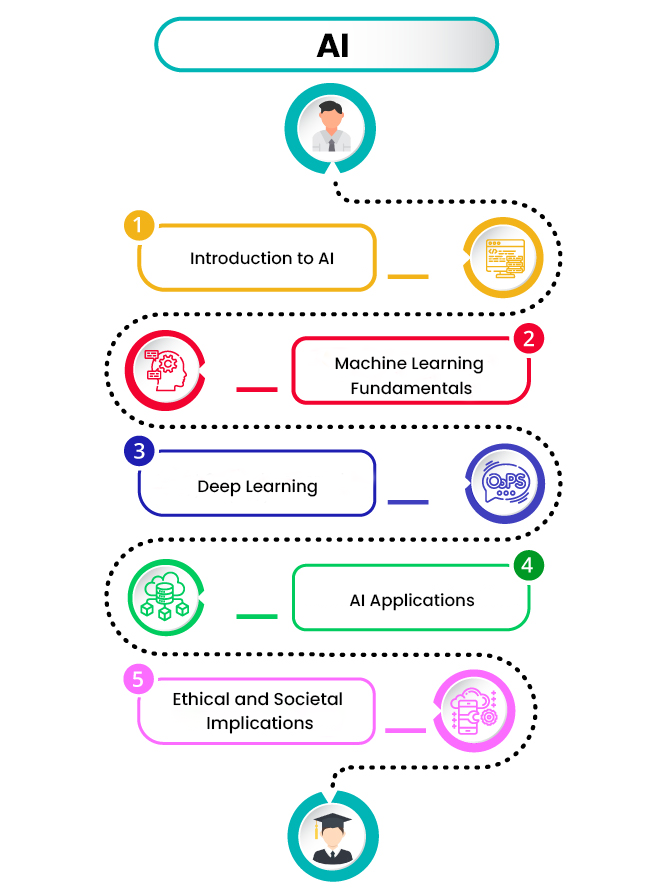
  • Introduction to AI and its applications
  • Machine learning algorithms and techniques
  • Deep learning fundamentals and neural networks
  • Natural language processing (NLP) and understanding
  • Computer vision and image recognition
  • Reinforcement learning
  • AI ethics, bias, and responsible AI practices
  • AI development tools and libraries (e.g., TensorFlow, PyTorch)
  • AI implementation and deployment strategies
  • Case studies and real-world applications of AI
  • The typical length of an Artificial Intelligence training course can vary widely depending on its depth, format, and intended audience. Short introductory courses or workshops may span a few days to a week, covering fundamental concepts and basic techniques. More comprehensive AI training programs, such as bootcamps or certificate programs, may last several weeks to several months, providing in-depth instruction and hands-on experience with AI tools and methodologies. Some universities also offer semester-long or year-long AI courses as part of their academic curriculum.

    The requirements to enroll in an Artificial Intelligence training course can vary depending on the course's level and prerequisites. While some introductory courses may have no specific requirements, more advanced AI courses may require a background in mathematics (particularly linear algebra and calculus) and programming. Familiarity with Python, as well as basic knowledge of statistics and probability, is often beneficial for AI training. However, many AI courses are designed to accommodate learners with diverse backgrounds and skill levels, providing necessary foundational instruction as part of the curriculum.

    Yes, there are often certifications available upon completing Artificial Intelligence training courses. These certifications can validate your proficiency in AI concepts, techniques, and tools, which can be valuable for career advancement and job opportunities. Certifications may be offered by educational institutions, professional organizations, or AI technology companies. The requirements and rigor of certification programs can vary, with some requiring passing exams, completing projects, or meeting other criteria to demonstrate competency in AI.

    Show More

    Yes, many online Artificial Intelligence courses do grant a certificate upon successful completion. These certificates can vary in terms of credibility and recognition depending on the institution or platform offering the course. It's important to research the reputation and accreditation of the course provider to ensure the certificate holds value in your desired field or industry.

  • Complexity of concepts
  • Lack of hands-on experience
  • Motivation and discipline
  • Limited interaction
  • Live webinars or virtual office hours where instructors answer questions in real-time.
  • Discussion forums or online communities where learners can ask questions, share insights, and interact with instructors and peers.
  • Email or messaging platforms where learners can communicate directly with instructors for personalized assistance or clarification on course materials.
  • Yes, there are specialized online Artificial Intelligence courses designed for particular career paths, such as data science or web development. These courses often focus on the specific skills and techniques needed for roles in these fields, providing targeted instruction to prepare learners for their desired career paths. Some platforms offer curated learning tracks or specialization options within their AI courses to align with different career goals and industry sectors.

  • Basic programming skills, particularly in languages commonly used in AI development such as Python.
  • Familiarity with fundamental concepts in mathematics, including linear algebra, calculus, and probability/statistics.
  • Some courses may specify additional prerequisites based on their content and difficulty level, so it's essential to review the course requirements before enrolling.
  • Set clear goals
  • Break it down
  • Stay engaged
  • Seek support
  • Stay curious
  • Take breaks
  • Show More
  • Working with real-world datasets
  • Building AI models
  • Implementing AI solutions
  • Experimentation and evaluation
  • Employee performance
  • Business impact
  • Project outcomes
  • Employee feedback
  • ROI calculation
  • Access to course materials
  • Mentorship and coaching
  • Online communities
  • Continuing education
  • Yes, employees with different levels of programming experience can derive value from Artificial Intelligence corporate training. Many training programs cater to learners with diverse backgrounds and skill levels, offering both introductory and advanced courses. Employees with limited programming experience can benefit from foundational courses that cover basic programming concepts alongside AI fundamentals. Meanwhile, employees with more programming experience can explore advanced topics and specialized techniques in AI development, such as deep learning or natural language processing, to deepen their expertise.

  • Driving innovation
  • Enhancing efficiency and productivity
  • Improving decision-making
  • Differentiating in the market
  • Per-learner pricing
  • Group pricing
  • Customized pricing
  • Subscription-based pricing
  • Show More