Artificial Intelligence Training In Hyderabad 100% Job Guarantee

  • Classes for Beginners and Professionals.
  • Best Coverage of MNC Interview Questions.
  • Programming Artificial Intelligence Through Interactive Learning.
  • The student portal and study materials are accessible for life.
  • Recruiting prospects: over 350, and over 12402 students trained.

Explore the factors that draw more than 25,000 students to ACTE.

Curriculum in Artificial Intelligence

Foundation of AI & ML
  • Introduction to Data Science, AI&ML
  • R Essentials
  • Statistical Analysis
  • Python for Artificial Intelligence
  • Python Essentials
  • Python Environment Setup
  • Python Data Types
  • Python Looping and Control Statements
  • Object-Oriented Programming Concepts
  • Database Connection
  • Python Libraries for Artificial Intelligence
  • Numpy
  • Scipy
  • Pandas
  • MatPlot
  • Data Management
  • Data Acquisition
  • Data Pre-processing and Preparation
  • Data Transformation and Quality
  • Handling Text Data
  • Big Data Fundamentals
  • Big Data Frameworks(Spark, Hadoop, NoSQL)
  • SAS-Data Analytics
  • SAS Introduction
  • SAS Functions
  • SAS Operators
  • SAS Procedures
  • SAS Graphs
  • SAS Macros
  • SAS Format
  • Statistical Decision Making
  • Data Visualisation
  • Sampling and Estimation
  • Inferential Statistics
  • Predictive Analytics
  • Linear Regression
  • Multiple Linear Regression
  • Non-Linear Regression
  • Forecasting Models
  • Machine Learning
  • ML Foundations
  • Clustering
  • Classification(Naive Bayes Classifier, K-Nearest Neighbors)
  • Association Rule Mining
  • Artificial Intelligence
  • Foundations of AI
  • Convolution Neural Networks
  • Recurrent Neural Networks
  • Deep Learning with Keras and TensorFlow
  • Deep Learning Libraries
  • Keras API
  • TensorFlow
  • Deep Learning Algorithms
  • Advanced Deep Learning and Computer Vision
  • Distributed and Parallel Computing
  • Deploying Deep Learning Models
  • Reinforcement Learning
  • Generating Images with Neural Style
  • Object Detection through Convolutional Neural Networks
  • Cloud Computing and AWS
  • Introduction to Cloud Computing and AWS
  • Storage Volumes and Elastic Compute
  • Virtual Private Cloud
  • Simple Storage Services
  • AWS Lambda and Amazon Machine Learning
  • Tableau 10
  • Introduction to Data Visualisation
  • Tableau Architecture
  • Working with Data Blending
  • Creation of Sets
  • Calculations, Expression, and Parameters
  • Dashboards, Stories, and Filters
  • Tableau Prep
  • Curriculum in Artificial Intelligence

    Artificial Intelligence Is Preferred by Over 35% of Developers. Artificial Intelligence is the most widely used and in-demand programming language in the IT industry.

    • Introduction to Data Science, AI&ML
    • R Essentials
    • Statistical Analysis
    • Python Essentials
    • Python Environment Setup
    • Python Data Types
    • Python Looping and Control Statements
    • Object-Oriented Programming Concepts
    • Database Connection
    • Numpy
    • Scipy
    • Pandas
    • MatPlot
    • Data Acquisition
    • Data Pre-processing and Preparation
    • Data Transformation and Quality
    • Handling Text Data
    • Big Data Fundamentals
    • Big Data Frameworks(Spark, Hadoop, NoSQL)
    • SAS Introduction
    • SAS Functions
    • SAS Operators
    • SAS Procedures
    • SAS Graphs
    • SAS Macros
    • SAS Format
    • Data Visualisation
    • Sampling and Estimation
    • Inferential Statistics
    • Linear Regression
    • Multiple Linear Regression
    • Non-Linear Regression
    • Forecasting Models
    • ML Foundations
    • Clustering
    • Classification(Naive Bayes Classifier, K-Nearest Neighbors)
    • Association Rule Mining
    • Foundations of AI
    • Convolution Neural Networks
    • Recurrent Neural Networks
    • Deep Learning Libraries
    • Keras API
    • TensorFlow
    • Deep Learning Algorithms
    • Distributed and Parallel Computing
    • Deploying Deep Learning Models
    • Reinforcement Learning
    • Generating Images with Neural Style
    • Object Detection through Convolutional Neural Networks
    • Introduction to Cloud Computing and AWS
    • Storage Volumes and Elastic Compute
    • Virtual Private Cloud
    • Simple Storage Services
    • AWS Lambda and Amazon Machine Learning
    • Introduction to Data Visualisation
    • Tableau Architecture
    • Working with Data Blending
    • Creation of Sets
    • Calculations, Expression, and Parameters
    • Dashboards, Stories, and Filters
    • Tableau Prep

    Artificial Intelligence Training Projects

    Develop Your Artificial Intelligence Skills With Useful and Interesting Projects.


    Sentiment Analysis

    Analyze the sentiment of text data to determine whether it is positive, negative, or neutral.


    Spam Email Classifier

    Build a classifier to identify spam emails using techniques like Naive Bayes or Support Vector Machines.


    Movie Recommendation System

    Develop a simple movie recommendation engine based on user preferences and historical ratings.


    Text Summarization

    Create a system that can generate concise summaries of longer texts, such as news articles or research papers.


    Fake News Detection

    Build a classifier to identify fake news articles by analyzing their content and source credibility.


    Music Generation

    Develop a model capable of generating new music compositions based on existing songs or musical patterns.


    Self-Driving Car Simulation

    Build a simulated environment where an AI agent learns to drive a car autonomously using reinforcement learning.


    Human Pose Estimation

    Develop a system to estimate the poses of humans in images or videos, including keypoint detection and pose tracking.


    Graph Neural Networks

    Apply GNNs to graph-structured data, including social networks or chemical structures, for analysis and prediction.

    Key Highlights

    Our Instructor

    Get advice from specialists who have certifications and are currently working.

    Artificial Intelligence Training Overview

    These tasks include understanding natural language, recognizing patterns in data, making predictions, and learning from experience. AI systems aim to mimic cognitive functions such as reasoning, problem-solving, perception, and decision-making, enabling them to automate tasks, assist humans in decision-making processes, and solve complex problems more efficiently. AI techniques encompass a broad range of approaches, including machine learning, deep learning, natural language processing, computer vision, and robotics. As AI technologies continue to advance, they have the potential to revolutionize industries ranging from healthcare and finance to transportation and entertainment, leading to new opportunities for innovation, productivity gains, and societal impact.

    Additional Information

    What goals are achieved in a Artificial Intelligence Course?

    In an artificial intelligence (AI) course, several goals are typically achieved to equip participants with the knowledge, skills, and competencies necessary to work in the field of AI. Some of the key goals include:

    • Participants gain a solid understanding of the fundamental concepts, principles, and techniques underlying artificial intelligence, including machine learning, deep learning, natural language processing, computer vision, and robotics.
    • Participants learn how to design, implement, and evaluate AI algorithms and models for various tasks such as classification, regression, clustering, sequence prediction, and reinforcement learning.
    • Participants engage in practical exercises, coding assignments, and projects to apply AI techniques to real-world problems, gaining hands-on experience with popular AI libraries, frameworks, and tools.
    • Participants develop critical thinking, problem-solving, and analytical skills essential for identifying, formulating, and solving AI-related challenges and optimizing AI systems for performance, accuracy, and efficiency.

    Future works for Artificial Intelligence

    • Enhancing the interpretability and transparency of AI models to make their decision-making processes more understandable and trustworthy, particularly in critical applications such as healthcare, finance, and criminal justice.
    • Addressing ethical considerations and societal implications of AI technologies, including issues related to fairness, bias, accountability, privacy, and the responsible deployment of AI systems in diverse cultural and socio-economic contexts.
    • Developing AI models that are robust to adversarial attacks and unforeseen circumstances, ensuring their reliability and resilience in real-world scenarios where they may encounter unexpected inputs or adversarial manipulation.
    • Advancing techniques for lifelong and continual learning, enabling AI systems to adapt and improve over time through experience, feedback, and exposure to new data and environments, without forgetting previously learned knowledge.

    What new Artificial Intelligence frameworks are there?

    • Developed by Google Research, JAX is an open-source library that provides composable function transformations in Python for high-performance numerical computing and machine learning research. It is particularly well-suited for building custom neural network architectures and training models with automatic differentiation.
    • Also developed by Google Research, Flax is a neural network library based on JAX that offers an intuitive and flexible interface for building and training deep learning models. It provides a functional programming style and supports features such as automatic mixed precision training, distributed computing, and advanced optimization algorithms.
    • PyTorch Lightning is a lightweight wrapper for PyTorch that simplifies the training process of deep learning models. It provides a high-level interface for organizing code, handling distributed training, and logging experiment metrics, allowing developers to focus on model design and experimentation.
    • It offers a scalable and efficient platform for training reinforcement learning agents with support for various algorithms, including deep Q-learning, policy gradients, and actor-critic methods.

    Trends and Techniques used in Artificial Intelligence

    Artificial intelligence (AI) is a rapidly evolving field, and several trends and techniques are shaping its development and application. Here are some of the prominent trends and techniques in AI:

    • ML remains one of the most significant trends in AI, with a focus on algorithms and models that can learn from data and make predictions or decisions without explicit programming. Deep learning, a subset of ML, has gained significant traction, particularly for tasks involving large datasets and complex patterns.
    • Deep learning techniques, such as convolutional neural networks (CNNs) and recurrent neural networks (RNNs), are widely used for tasks such as image recognition, natural language processing, and sequential data analysis. Advances in deep learning architectures, training algorithms, and hardware acceleration have led to breakthroughs in various AI applications.
    • Recent advancements in NLP, fueled by transformer-based models like BERT and GPT, have led to significant improvements in tasks such as language translation, sentiment analysis, text summarization, and question answering.
    • Computer vision techniques enable computers to interpret and analyze visual information from images or videos. Deep learning-based approaches, combined with techniques such as object detection, image segmentation, and image generation, have led to breakthroughs in areas such as autonomous vehicles, medical imaging, facial recognition, and surveillance systems.
    Show More

    Enter details. Get MNC calls!

    Artificial Intelligence Training Objectives

  • Foundational knowledge in mathematics, including calculus, linear algebra, and probability theory.
  • Proficiency in programming languages commonly used in AI development, such as Python, Java, or R.
  • Familiarity with basic concepts in computer science, including algorithms, data structures, and computer architecture.
  • Understanding of fundamental AI concepts and techniques, such as machine learning, deep learning, natural language processing, and computer vision.
  • Validates your expertise and proficiency in AI technologies.
  • Enhances your credibility and marketability as an AI professional.
  • Increases your job prospects and opportunities for career advancement.
  • Provides a structured framework for acquiring and mastering AI skills.
  • Keeps you updated with the latest trends, tools, and best practices in the field of AI.
  • Machine Learning Engineer
  • Data Scientist
  • AI Researcher
  • Natural Language Processing (NLP) Engineer
  • Computer Vision Engineer
  • AI Software Developer
  • AI Consultant
  • AI Product Manager
  • Robotics Engineer
  • Business Intelligence Analyst
  • Enhancing your credentials and qualifications for AI-related roles.
  • Demonstrating your expertise and proficiency in AI technologies to employers.
  • Opening up new job opportunities and career paths in the rapidly growing field of AI.
  • Providing a competitive edge in the job market by distinguishing you from other candidates.
  • Increasing your earning potential and opportunities for promotions and leadership roles.
  • Offering opportunities for continuous learning and professional development to stay relevant in the evolving AI landscape.
  • Google Cloud AI Platform Professional Certificate
  • IBM AI Engineering Professional Certificate
  • Microsoft Certified: Azure AI Fundamentals
  • AWS Certified Machine Learning - Specialty
  • NVIDIA Deep Learning Institute (DLI) Certifications
  • Coursera Machine Learning Specialization
  • edX Artificial Intelligence MicroMasters Program
  • Vendor-specific certifications (e.g., Google Cloud AI, IBM AI Engineering)
  • Industry-recognized certifications (e.g., Microsoft Certified: Azure AI)
  • Professional certifications (e.g., Certified Artificial Intelligence Professional)
  • Academic certifications (e.g., Graduate Certificate in Artificial Intelligence)
  • Specialized certifications focusing on specific AI technologies or applications (e.g., Deep Learning, Natural Language Processing)
  • Show More

    Industry Statistics

    Jobs / Month

    248

    Avg. Salary

    ₹ 12,55,200

    Job Roles

    AI/ML Engineer

    Data Scientist

    Robotics Engineer

    AI Consultant

    Artificial Intelligence Certification

    Certificate
    GET A SAMPLE CERTIFICATE
  • Validation of expertise and proficiency in AI technologies.
  • Enhanced credibility and marketability as an AI professional.
  • Increased job prospects and opportunities for career advancement.
  • Access to exclusive job opportunities and higher salary prospects.
  • Structured learning and skill development in specialized areas of AI.
  • Recognition by employers and industry stakeholders.
  • Validation of knowledge and proficiency in AI-related fields.
  • Increased marketability and reputation in the employment market.
  • Enhanced chances for employment and professional growth.
  • Access to better compensation possibilities and exclusive work opportunities.
  • Specialized AI skill growth and organized learning.
  • Acknowledgment from industry stakeholders and employers.
  • Dedication to lifelong learning and professional growth displayed.
  • While obtaining an artificial intelligence certification can significantly improve your job prospects and increase your competitiveness in the job market, it does not guarantee employment on its own. Job opportunities ultimately depend on various factors, including your experience, skills, education, networking, and the demand for AI professionals in the industry.

    Specific requirements prior to taking artificial intelligence certification exams may vary depending on the certification program and provider. However, common prerequisites may include foundational knowledge in mathematics, proficiency in programming languages such as Python or R, familiarity with AI concepts and techniques, and completion of relevant coursework or training.

  • Review the exam blueprint or syllabus to understand the topics covered.
  • Enroll in a certification training program or course to gain knowledge and skills.
  • Practice with sample questions and exam simulations to familiarize yourself with the format.
  • Study relevant textbooks, online resources, and documentation to deepen your understanding of AI concepts.
  • Work on hands-on projects and labs to apply your knowledge in real-world scenarios.
  • Review your progress and areas of weakness regularly and adjust your study plan accordingly.
  • Yes, many artificial intelligence certification exams offer an online version that allows candidates to take the exam remotely from their own computers. Online proctoring services ensure the integrity and security of the testing process by monitoring candidates via webcam and screen sharing.

    While practical experience can be beneficial for obtaining an artificial intelligence certification, it is not always a strict requirement. Certification programs typically focus on assessing knowledge and skills in AI concepts, techniques, and tools, rather than practical experience. However, having hands-on experience with AI projects and applications can enhance your understanding and readiness for certification exams.

    The investment of time and money in an ACTE artificial intelligence certification can be justified based on various factors, including the reputation of the certification program, the relevance of the skills learned, and the demand for certified professionals in the job market. ACTE is a reputable training institute known for providing high-quality education and industry-relevant certifications. An artificial intelligence certification from ACTE can enhance your qualifications, improve job prospects, and validate your expertise in AI technologies. However, it's essential to research and evaluate the specific certification program to ensure it aligns with your career goals and objectives.

    Show More

    The Preferred Partner for 100+ Organizations' Hiring

    Learn from the certified and real time working professionals.

    • Over 100 firms that are looking for top talent for their open positions have come to rely on ACTE as their go-to partner.

    • Businesses have confidence in our ability to match them with the best individuals because of our considerable expertise and proven track record of success.

    • In this section, we'll examine the primary elements influencing this trust and examine how our constant commitment to excellence regularly results in remarkable results for our clients.

    Corporate Clients

    Artificial Intelligence Course Duration and Fees

    Level Course Duration Fees Structure
    Basic 1 - 1.5 Months ₹7,000 - ₹9,000
    Advanced 1.5 - 2 Months ₹7,000 - ₹10,000

    Job Opportunities in Artificial Intelligence

    Artificial Intelligence is preferred by more than 35% of developers. The most widely used and in-demand programming language in the tech industry is Artificial Intelligence.

    Salary In Artificial Intelligence
    Reach Our Placement Officer

    You can Work as a

    AI Product ManagerAI Ethics SpecialistAI ArchitectAI TrainerAI Curriculum DeveloperAI Project ManagerData Engineer

    Upcoming In-Demand Jobs

    Data AnalystData ScientistAI ProgrammerAI Systems EngineerAI Software Developer

    Student Testimonials

    100% Placement

    7000+ Placed Student

    600+ Hiring Partners

    5.5 LPA Average Salary

    Recently Placed Students

    Artificial Intelligence Training FAQ's

    Boost Your Coding Ability: Essential Artificial Intelligence Training for Novices and Experienced

    A specialized area of computer science called artificial intelligence (AI) is concerned with building devices and systems that can carry out operations that normally call for human intellect. Education thinking, figuring out solutions, perceptions, comprehending conversational language, and engaging with the surroundings are some of these activities.

    The term "artificial intelligence training" describes instructional plans, classes, or seminars intended to provide people with knowledge of AI principles, methods, resources, and applications. The goal of AI training is to provide participants the information and abilities they need to efficiently design, build, and operate AI systems.

  • Career opportunities
  • Innovation and problem-solving
  • Competitive advantage
  • Future readiness
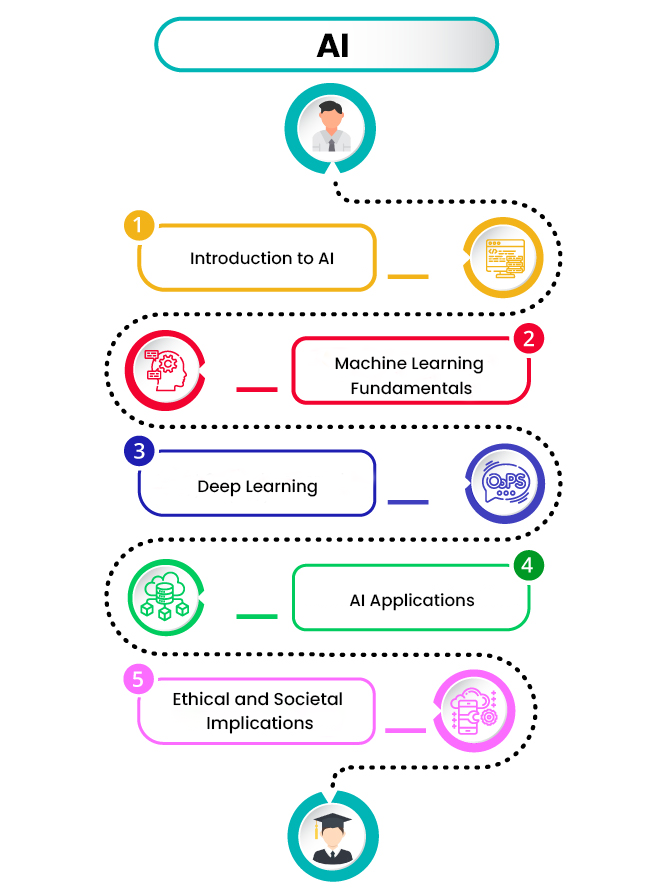
  • Introduction to AI
  • Machine learning
  • Neural networks
  • Natural language processing (NLP)
  • Computer vision
  • AI ethics and societal impact
  • AI tools and libraries
  • AI applications
  • The duration of Artificial Intelligence training can vary depending on factors such as the depth of coverage, the level of the course (introductory, intermediate, advanced), and the mode of delivery (self-paced online, instructor-led classroom, bootcamps). Some courses may be completed in a few weeks, while others may span several months or longer for more comprehensive training programs.

  • Review exam objectives
  • Study materials
  • Practice exams
  • Hands-on experience
  • Join study groups
  • Time management
  • Review and revise
  • Show More
  • Basic programming skills
  • Familiarity with mathematics
  • Computer science fundamentals
  • Set clear goals
  • Break it down
  • Stay engaged
  • Connect with peers
  • Find inspiration
  • Take breaks
  • Attend lectures and review materials
  • Practice coding
  • Seek clarification
  • Experiment and explore
  • Stay organized
  • Review regularly
  • Yes, it is feasible to acquire Artificial Intelligence skills through online learning without any prior programming experience. Many online AI courses cater to learners with diverse backgrounds and skill levels, offering introductory courses that cover basic programming concepts alongside AI fundamentals. These courses often provide step-by-step instruction, practical examples, and hands-on exercises to help beginners build foundational skills in AI development.

    Yes, many online Artificial Intelligence courses do furnish participants with certificates upon course completion. These certificates can serve as proof of your proficiency in AI concepts and may be useful for career advancement or further education. However, it's essential to research the credibility and recognition of the issuing institution or platform to ensure the certificate holds value in your desired field or industry.

    Yes, online Artificial Intelligence training can be effective for beginners. Many online courses are designed to accommodate learners with diverse backgrounds and skill levels, offering introductory courses that provide comprehensive instruction in AI concepts and techniques. These courses often feature interactive learning materials, practical examples, and hands-on exercises to help beginners build a strong foundation in AI development. Additionally, online learning allows beginners to learn at their own pace, access resources, and seek support from instructors and peers, making it an accessible and effective learning option for those new to AI.

    Show More

    Artificial Intelligence (AI) corporate training refers to educational programs, workshops, or courses designed specifically for businesses and their employees to learn about AI concepts, techniques, tools, and applications relevant to their industry or organizational needs. It is essential for organizations because AI technologies are increasingly being adopted across various sectors to drive innovation, improve efficiency, and gain a competitive edge. By investing in AI corporate training, organizations can equip their employees with the knowledge and skills needed to leverage AI effectively, address business challenges, and capitalize on opportunities for growth and transformation.

  • Building AI competency
  • Driving innovation
  • Enhancing productivity
  • Fostering collaboration
  • Customizing content
  • Targeting roles and skill levels
  • Incorporating real-world scenarios
  • Providing hands-on experience
  • The usual duration of an Artificial Intelligence corporate training program can vary depending on factors such as the depth of coverage, the level of customization, and the organization's training goals and objectives. Some training programs may be delivered over a few days as intensive workshops or boot camps, while others may span several weeks or months for more comprehensive training initiatives. The duration of the training program can be adapted to fit the company's timetable and scheduling preferences, with options for flexible delivery formats, on-site or remote training, and modularized content to accommodate employees' availability and work commitments.

    Instructors for Artificial Intelligence corporate training typically possess a combination of academic qualifications, professional expertise, and industry experience in the field of AI. They may have advanced degrees in computer science, engineering, mathematics, or related disciplines, with specialization or research focus in AI, machine learning, or data science. Additionally, instructors often have practical experience working with AI technologies in industry settings, such as software development, research, consulting, or project management roles. They may hold certifications or credentials in AI-related disciplines and demonstrate a track record of delivering effective training and coaching to individuals or organizations.

  • Introduction to AI
  • Machine learning
  • Neural networks
  • Natural language processing (NLP)
  • Computer vision
  • AI tools and platforms
  • AI applications
  • Show More